Time, reactive state & logic
This page covers temporal/reactive signal processing (phyelds.libraries.time) and formal spatial/temporal property monitoring (phyelds.libraries.logic).
Time & reactive state: phyelds.libraries.time
Real collective systems often need timers, synchronized clocks, edge detection, smoothing filters, and periodic state resets.
Clocks, timers, and time replication
| Function | Returns |
|---|---|
local_time() |
Current timestamp of the device (sense("time"), default 0.0) |
delta_time(clock=None) |
Elapsed time since the previous round on this device (0.0 on round 1) |
shared_clock(clock=None) |
Monotonic network-wide clock synchronized via gossip to the fastest device |
timer(duration, *, periodic=False, clock=None) |
Countdown starting at duration and reaching 0.0 (auto-restarts when periodic=True) |
periodic_impulse(period, *, clock=None) |
True for a single round once every period time units |
recently_true(condition, duration, *, clock=None) |
True while condition holds and for duration time units after it becomes False |
time_replicated(process, period, *, max_replicas=2, clock=None) |
Runs process in overlapping time-windowed replicas so stale state is periodically discarded |
Reactive state and signal operators
| Function | Returns |
|---|---|
delay(value, initial=None) |
The value value had on this device in the previous round (initial on round 1) |
has_changed(value, *, initially=False) |
True on rounds where value != delay(value) |
rising_edge(condition) |
True on the round where condition transitions False → True |
falling_edge(condition) |
True on the round where condition transitions True → False |
once(value) |
Returns value on the first round and None on every subsequent round |
exponential_filter(signal, alpha) |
Exponential moving average of signal with smoothing factor alpha in [0, 1] |
counter() |
Number of rounds this call site has executed (1, 2, 3, ...) |
decay(value, rate) |
Starts at value and decreases by rate each round down to 0 |
from phyelds.calculus import aggregate
from phyelds.libraries.device import sense
from phyelds.libraries.time import exponential_filter, recently_true, rising_edge

@aggregate
def smoke_detector():
    smooth_temp = exponential_filter(sense("temperature"), alpha=0.3)
    spike = rising_edge(smooth_temp > 75.0)
    # Keep the alert active for 10.0 seconds after any temperature spike
    return recently_true(spike, duration=10.0)
Spatial & temporal logic: phyelds.libraries.logic
phyelds.libraries.logic brings formal runtime verification directly into aggregate programs, implementing Spatial Logic for Closure Spaces (SLCS) and Past Computation Tree Logic (Past-CTL) (from FCPP).
Spatial Logic for Closure Spaces (SLCS)
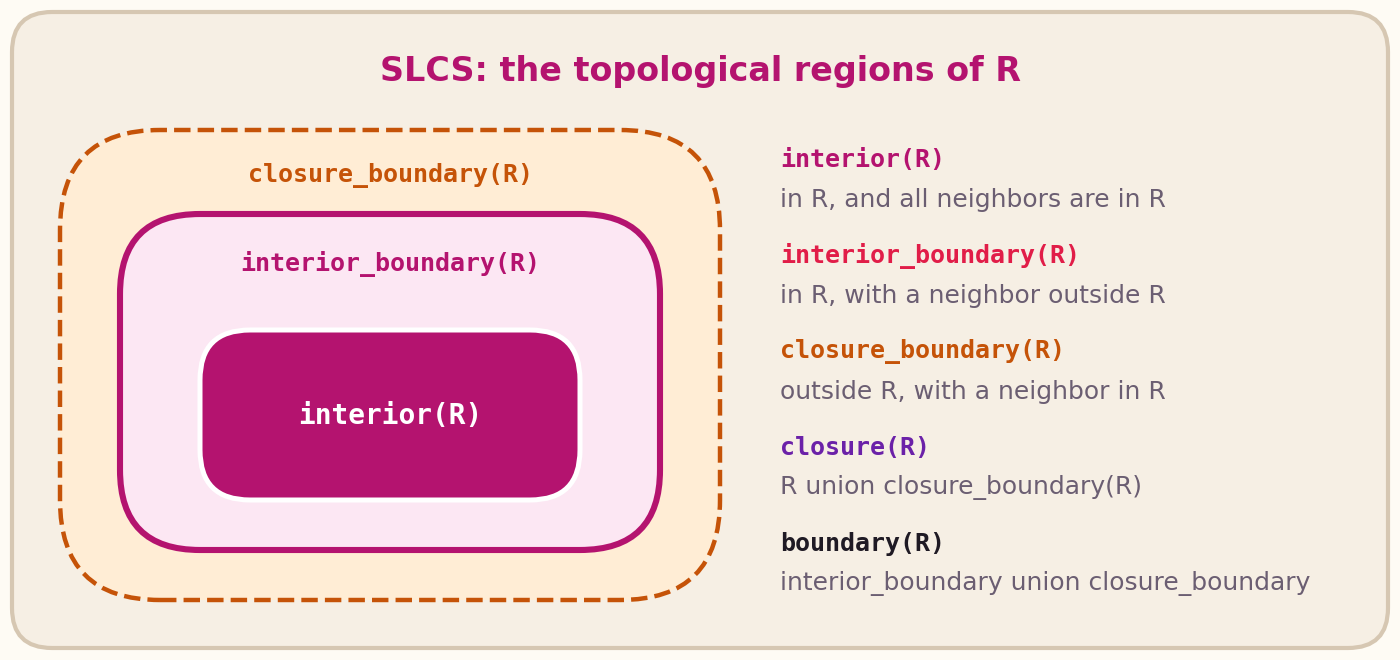
Given a boolean field region (where True marks nodes inside the region), SLCS operators classify the topological structure of the region and its reachability:
| Spatial operator (SLCS) | Returns |
|---|---|
interior(region) |
True on nodes in region whose neighbors are all in region |
closure(region) |
True on nodes that are in region or have at least one neighbor in region |
boundary(region) |
closure(region) and not interior(region) (both the inner and outer borders) |
interior_boundary(region) |
region and not interior(region) (nodes in region touching the outside) |
closure_boundary(region) |
closure(region) and not region (nodes outside region touching region) |
somewhere(condition, *, max_diameter=20.0, strategy=None) |
True if condition holds on at least one reachable device within max_diameter |
everywhere(condition, *, max_diameter=20.0, strategy=None) |
True if condition holds on all reachable devices within max_diameter |
reaches(region, target, *, max_diameter=20.0, strategy=None) |
True if a path staying entirely inside region reaches a target device |
touches(region, target, *, max_diameter=20.0, strategy=None) |
True on devices in region whose connected component is adjacent to a target |
surrounds(region, barrier, *, max_diameter=20.0, strategy=None) |
True on devices in region that are completely enclosed by barrier nodes |
from phyelds.calculus import aggregate
from phyelds.libraries.device import sense
from phyelds.libraries.logic import interior_boundary, reaches

@aggregate
def safe_evacuation():
    safe_zone = not sense("hazard")
    can_reach_exit = reaches(safe_zone, sense("is_exit"), max_diameter=30.0)
    on_hazard_perimeter = interior_boundary(safe_zone)
    return can_reach_exit, on_hazard_perimeter
Past Computation Tree Logic (Past-CTL)
Past-CTL operators evaluate temporal properties over a device's own execution history (scope="local"), across all aligned neighbors (scope="all", universal past), or across any aligned neighbor (scope="any", existential past / causal cone):
| Temporal operator (Past-CTL) | Returns (scope="local" \| "all" \| "any") |
|---|---|
yesterday(condition, *, scope="local") |
Whether condition held in the previous round (locally, in all neighbors, or in any neighbor) |
since(sustained, triggered, *, scope="local") |
Whether sustained has held continuously since a round where triggered occurred |
previously(condition, *, scope="local") |
Whether condition held at least once in the past (since(True, condition, scope=...)) |
historically(condition, *, scope="local") |
Whether condition has held in every round so far (not previously(not condition, scope=...)) |