Spreading, collection & gossip
This page covers the core spatial propagation libraries: Spreading (G), Collection (C), and Gossip.
Spreading: phyelds.libraries.spreading
Spreading functions propagate distances and data outward from one or more source devices (where source is True).
| Function | Returns |
|---|---|
distance_to(source, distances=None, *, strategy=None) |
The gradient: shortest distance from the nearest device where source is True |
broadcast(source, data, distances=None, *, strategy=None) |
The data of the nearest source, propagated outward along the gradient |
cast_from(source, data, accumulation, distances=None, *, strategy=None) |
Like broadcast, applying accumulation(current, step_dist) at each hop |
distance_between(source, target, distances=None, *, strategy=None) |
The shortest distance between source and target, broadcast across the network |
channel(source, target, width=0.0, distances=None, *, strategy=None) |
True on devices on a route from source to target at most width longer than the shortest one |
When distances is omitted, hops_distance() (1 per hop) is used; pass neighbors_distances() for metric Euclidean distances.
Choosing a spreading strategy: bellman_ford vs. path_coherent
All spreading functions accept a pluggable strategy:
bellman_ford()(default): classic Bellman-Ford relaxation usingrememberandneighbors. Lightweight, but suffers from the rising-value problem when all sources disappear or jump far away (stale low estimates slowly count up).path_coherent(max_diameter=...): fast self-healing gradient built onexchangeand loop-freePathValueroutes. When a source disappears, any route that previously depended on it is invalidated immediately instead of looping through neighbors.
from phyelds.calculus import aggregate
from phyelds.libraries.device import local_id, sense
from phyelds.libraries.distances import neighbors_distances
from phyelds.libraries.spreading import broadcast, path_coherent

@aggregate
def nearest_station_id():
    # Every device learns the ID of the nearest station via a fast self-healing gradient
    return broadcast(
        sense("is_station"),
        local_id(),
        neighbors_distances(),
        strategy=path_coherent(max_diameter=20),
    )
Collection: phyelds.libraries.collect
Collection (C) is the dual of spreading: values flow inward (downhill along a potential field, such as a gradient) toward the source(s), accumulating along the way.
| Function | Returns (at the sink: aggregated over the whole basin) |
|---|---|
find_parent(potential) |
The ID of the neighbor with the lowest potential (None at a local minimum) |
find_parents(potential, predicate=None) |
The set of all neighbor IDs whose potential is strictly lower than the device's own |
collect_with(potential, local, accumulation, *, strategy=None) |
local values accumulated downhill with accumulation(a, b) |
count_nodes(potential, *, strategy=None) |
Total number of devices in the basin |
sum_values(potential, local, *, strategy=None) |
Sum of local over all devices in the basin |
mean_values(potential, local, *, strategy=None) |
Arithmetic mean of local over all devices in the basin |
collect_or(potential, local, *, strategy=None) |
True on nodes whose subtree contains at least one device with local == True |
summarize(sink, local, accumulation, distances=None, ...) |
Collects local into sink and broadcasts the aggregated result back to all devices (G → C → G) |
Choosing a collection strategy
Collection functions support three pluggable routing strategies:
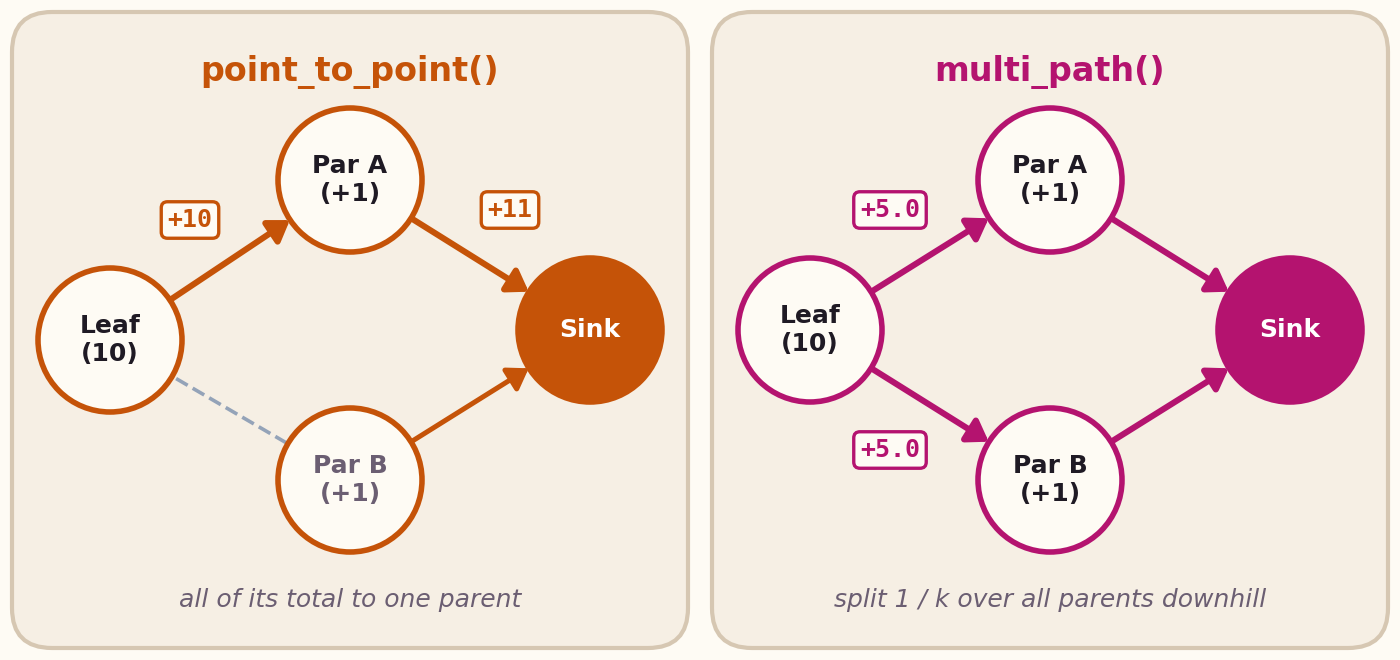
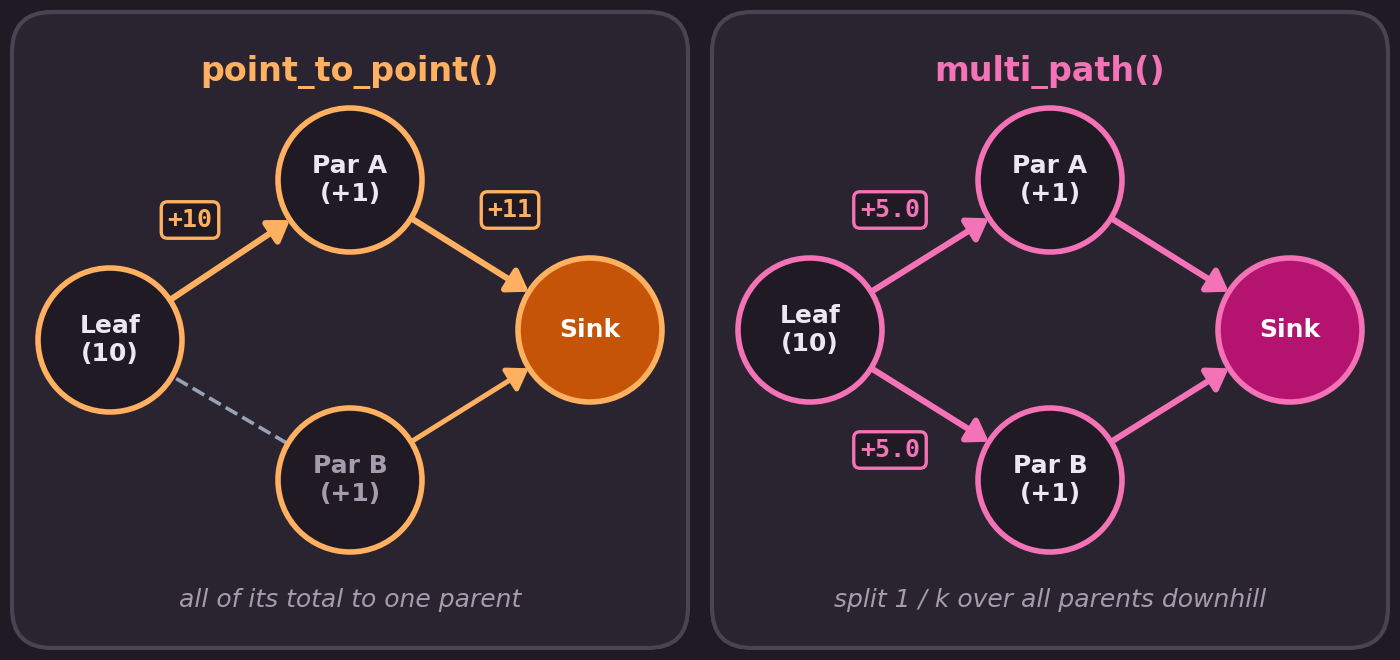
broadcast_collect()(default): each node selects its single best parent (find_parent(potential)) and advertises(parent_id, total)vianeighbors.point_to_point(): uses an anisotropicexchangeso each device sends its accumulated total only to its selected parent andidentityto everyone else.multi_path(): builds a Directed Acyclic Graph (DAG) toward all downhill neighbors (find_parents(potential)) and splits each node's value equally (1 / len(parents)) across all parents usingdivider. More resilient to link changes than a single spanning tree.
from phyelds.calculus import aggregate
from phyelds.libraries.collect import count_nodes, point_to_point
from phyelds.libraries.device import sense
from phyelds.libraries.spreading import distance_to

@aggregate
def network_size():
    potential = distance_to(sense("source"))
    return count_nodes(potential, strategy=point_to_point())
Combining spreading and collection: a corridor
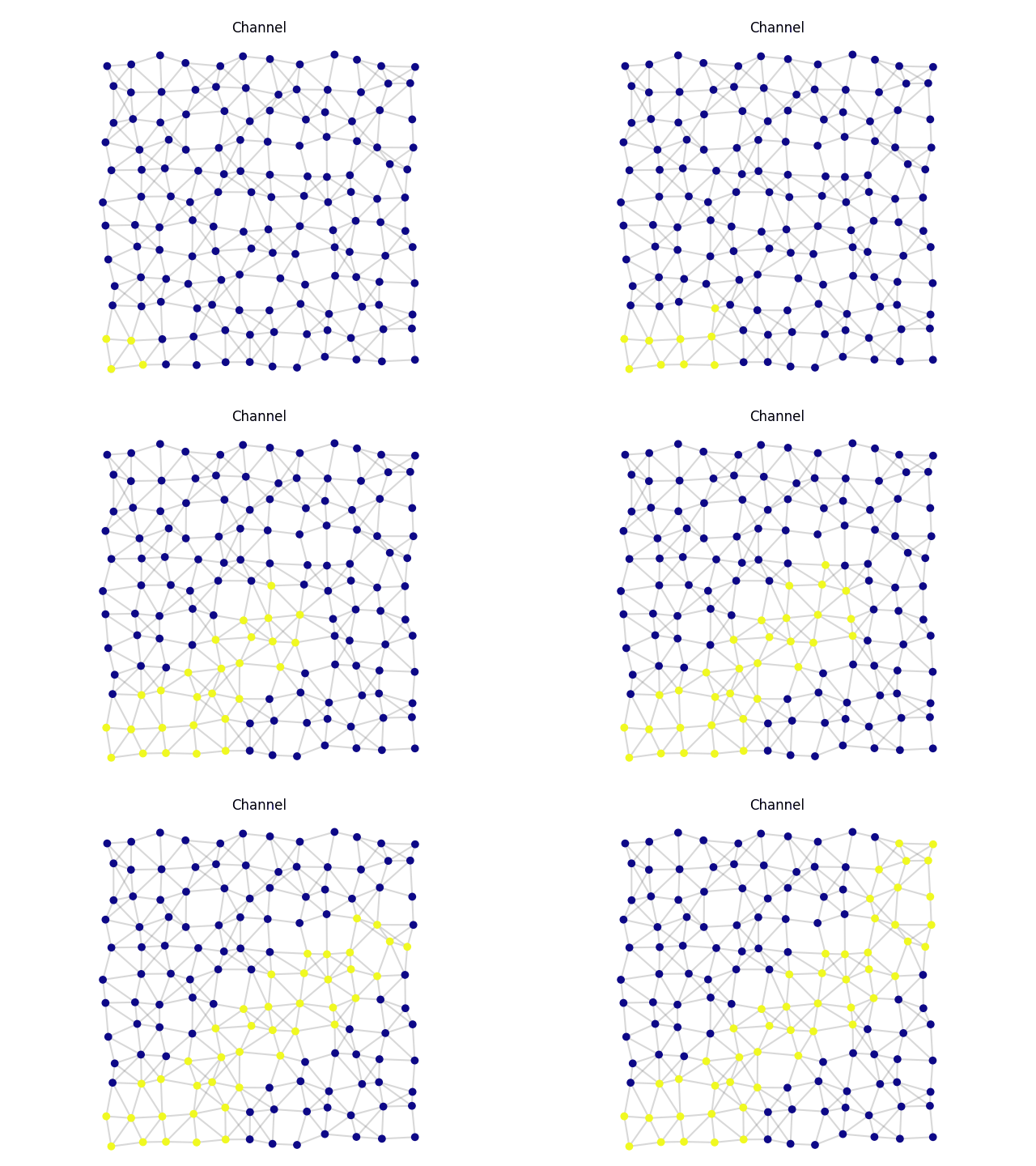
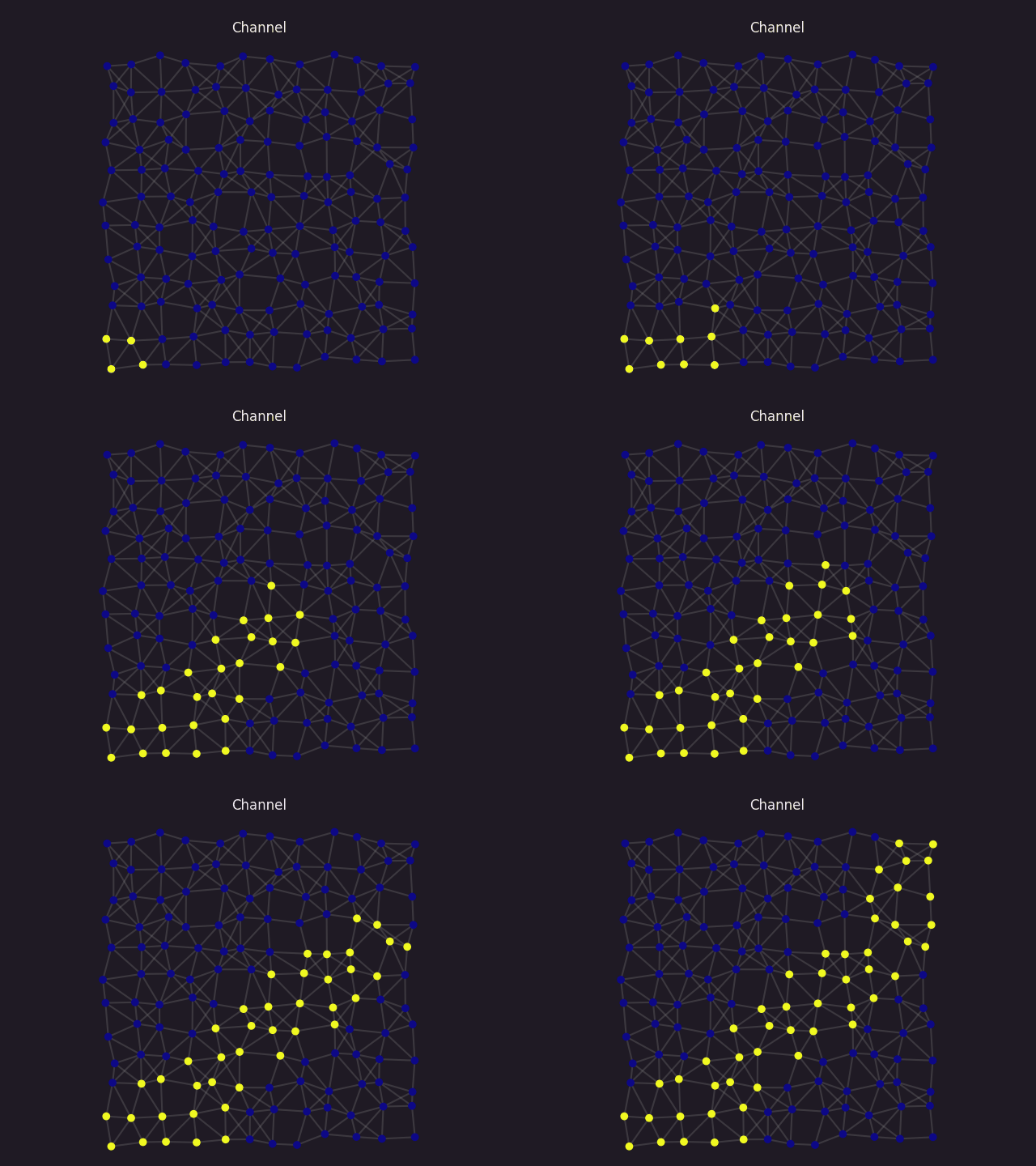
A gradient towards a target, collect_or along it from a source, and a second gradient from the devices it marks create a self-healing corridor: the devices within width of the shortest path (the tutorial builds it step by step). Unlike channel, whose width is a slack on the length of the route (the playground runs it term by term), here width is a distance from the path:
Gossip: phyelds.libraries.gossip
Gossip functions compute global extrema or consensus across the network without requiring a source or a gradient.
| Function | Returns |
|---|---|
gossip_min(value, *, key=None, strategy=None) |
The minimum of value across the network |
gossip_max(value, *, key=None, strategy=None) |
The maximum of value across the network |
gossip_mean(value) |
Iterative local neighborhood averaging of value |
gossip(value, callback, *, strategy=None) |
Combines value across the network using an associative, idempotent callback (e.g., set.union) |
any_node(condition, *, strategy=None) |
Whether condition holds on at least one device in the network |
stabilizing_gossip(value, max_diameter, callback) |
Hop-bounded gossip that forgets contributions farther than max_diameter hops |
Choosing a gossip strategy
monotonic_gossip()(default): fast 1-state gossip (remember+neighbors). Note that monotonic gossip never forgets an extreme value (e.g., if the node holding the global minimum leaves, its minimum remains in the network).path_coherent_gossip(max_diameter=...): spatial self-stabilizing gossip based on loop-freePathValueroutes. Immediately adapts when values increase or devices leave.time_replicated_gossip(period, max_replicas=2): temporal self-stabilizing gossip that runs overlapping time-windowed replicas and periodically discards obsolete values.