Collective state machines
Experimental
This is a study in progress: its API will probably change.
A collective state machine (cFSM) is a finite state machine run by a whole collective: its states are collective behaviours (explore, defend), its transitions are collective agreements. A device senses an event and proposes a transition; the network makes it a decision of everyone. This module implements the model of Macroscopic Design of Swarms with Collective State Machines (Aguzzi, Audrito, Girau, Torta, Casadei, ICCCI 2026), whose experiments are in ScaFi; the definitions below are the paper's.
from phyelds.experimental.state_machines import StateMachine
Describing a machine
A StateMachine lists its states; each state is a function, which does what a device
does in that state and, from what happens, proposes where to go:
mission = StateMachine("wait", "explore", "defend")

@mission.state("explore", to=["defend"])
def explore():
    velocity = sink_at(sense("leader"))               # what the drone does
    if sense("attack"):
        mission.go("defend", priority=math.inf)       # where the swarm should go
    return velocity

@aggregate
def drone():
    state, velocity = mission.run()
Here the drone moves with a swarm behaviour; the example there is a mission whose phases are a machine.
- States: strings, numbers, or the members of an enum. The machine starts in the first one. Devices send the position of a state, not the state, so a long name costs nothing in the messages.
@mission.state(name, to=[...]): the function of a state. It runs aligned on the state, so it can useremember,neighborsand the libraries on its own: a timer started in a state restarts when the machine enters it again. Decorate it with@aggregatetoo if it calls them in branches, as any other function.tolists the states it may go to: optional, but it lets the machine check them and draw itself.mission.go(state, priority=...): from the function of a state, proposes a transition (see priorities below). A function that does not call it stays.mission.run(): runs a round, and returns the state the device agreed on and what its function returned.mission.to_mermaid(): the diagram of the declared transitions.
How it works
A history is the sequence of prioritised states (priority, state) the machine went
through, from the initial one (Definition 3). It never loops, but at its end: while the
machine stays in a state, the history ends with a self-loop, which records the
priority of staying. In every round, each device (Definition 6):
- Agrees. It takes the maximum of the histories its neighbors sent, its own included: histories are compared lexicographically, each entry by priority, then by state, and a prefix is smaller (Definition 5). A transition spreads to the whole network, hop by hop.
- Acts. It runs the program of the last state of that history, aligned on it.
- Extends. It extends the history with the prioritised state the program produced: a final self-loop is replaced, any other entry is kept (Definition 4). It sends the result to its neighbors.
The program of a state produces the greatest of staying, with the lowest priority, and
of the transitions it proposes with go (Remark 1). Two devices can propose different
transitions at once: the histories diverge, and the first entry that differs decides,
the higher priority first, then the state declared later.
Priorities
Staying has the lowest priority, and is recorded too: a transition with the same
priority wins only if it goes to a later state. A transition to an earlier state
needs a higher priority. The case study of the paper gives standard transitions the
time they happen, negated, so that the earlier wins, and the urgent ones math.inf:
mission.go("wait", priority=-local_time())
mission.go("defend", priority=math.inf)
Example: a search-and-rescue mission
The case study of the paper, without the movement: a swarm of drones waits at the base (bottom left), explores when an alarm goes off, rescues when a drone finds the target (top right), and defends the base when it is attacked. Each event is sensed by one drone only. In each phase, a drone also computes how far it is from where it heads: the base or the target.
stateDiagram-v2
    [*] --> WAIT
    WAIT --> EXPLORE
    WAIT --> DEFEND
    EXPLORE --> RESCUE
    EXPLORE --> DEFEND
    RESCUE --> WAIT
    DEFEND --> WAIT
class Phase(IntEnum):
"""
The phases of the mission. As in the paper, a transition has the priority of the
time it happens, negated, so that the earlier wins; defending the base wins over all.
"""
WAIT = 0
EXPLORE = 1
RESCUE = 2
DEFEND = 3
mission = StateMachine(*Phase)
@mission.state(Phase.WAIT, to=[Phase.EXPLORE, Phase.DEFEND])
def wait() -> float:
"""Stay at the base, until an alarm or an attack."""
if sense("attack"):
mission.go(Phase.DEFEND, priority=math.inf)
elif sense("alarm"):
mission.go(Phase.EXPLORE, priority=-local_time())
return distance_to(sense("base"), neighbors_distances())
@mission.state(Phase.EXPLORE, to=[Phase.RESCUE, Phase.DEFEND])
def explore() -> None:
"""Search the area, until a drone finds the target or the base is attacked."""
if sense("attack"):
mission.go(Phase.DEFEND, priority=math.inf)
elif sense("found"):
mission.go(Phase.RESCUE, priority=-local_time())
@mission.state(Phase.RESCUE, to=[Phase.WAIT])
def rescue() -> float:
"""Head for the target, until it is rescued."""
if sense("rescued"):
mission.go(Phase.WAIT, priority=-local_time())
return distance_to(sense("found"), neighbors_distances())
@mission.state(Phase.DEFEND, to=[Phase.WAIT])
def defend() -> float:
"""Head for the base, until it is safe."""
if sense("safe"):
mission.go(Phase.WAIT, priority=-local_time())
return distance_to(sense("base"), neighbors_distances())
@aggregate
def drone() -> Phase:
"""The program every drone runs: the phase it agrees on, and how far it has to go."""
phase, distance = mission.run()
store("distance", distance)
return phase
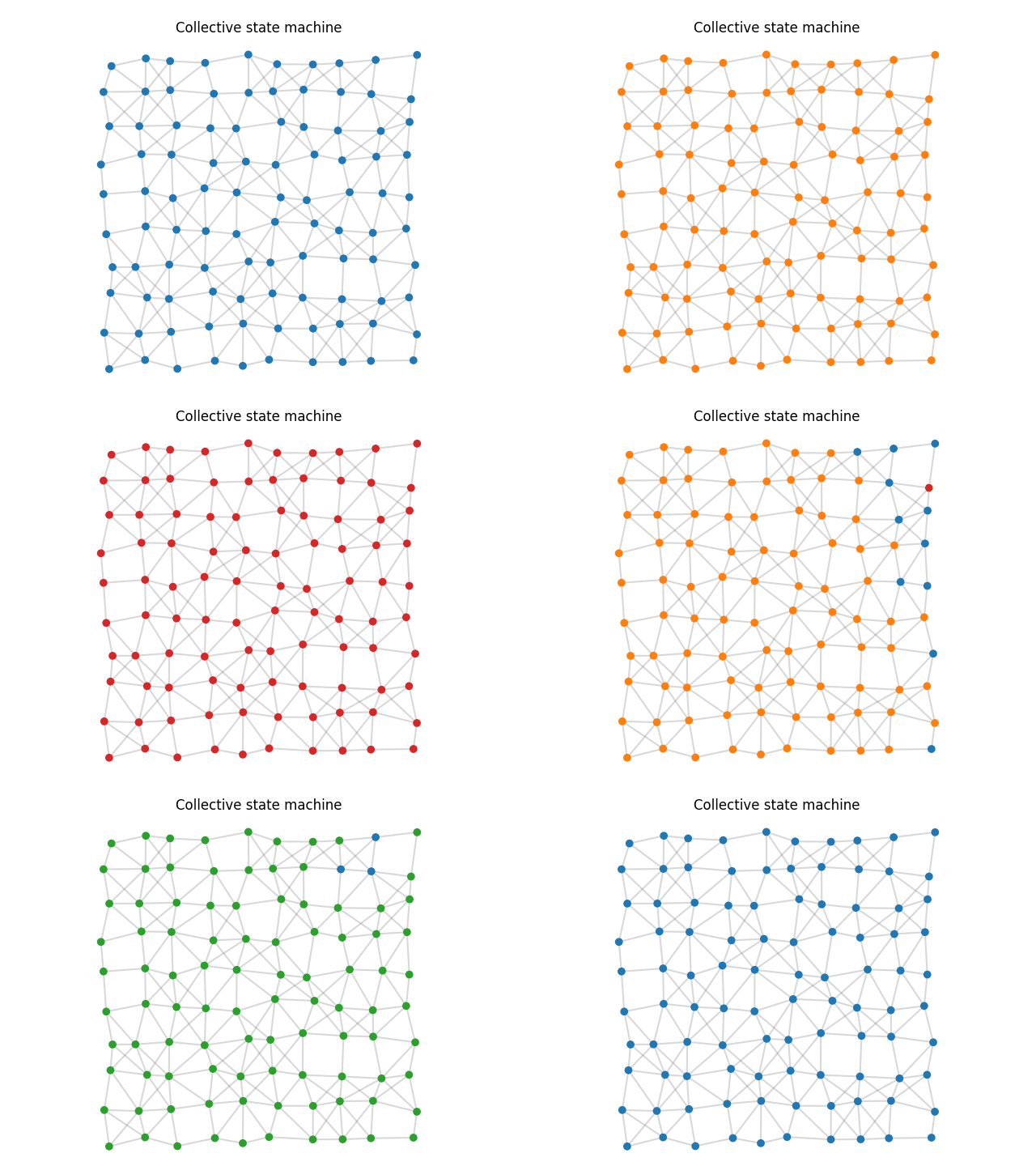
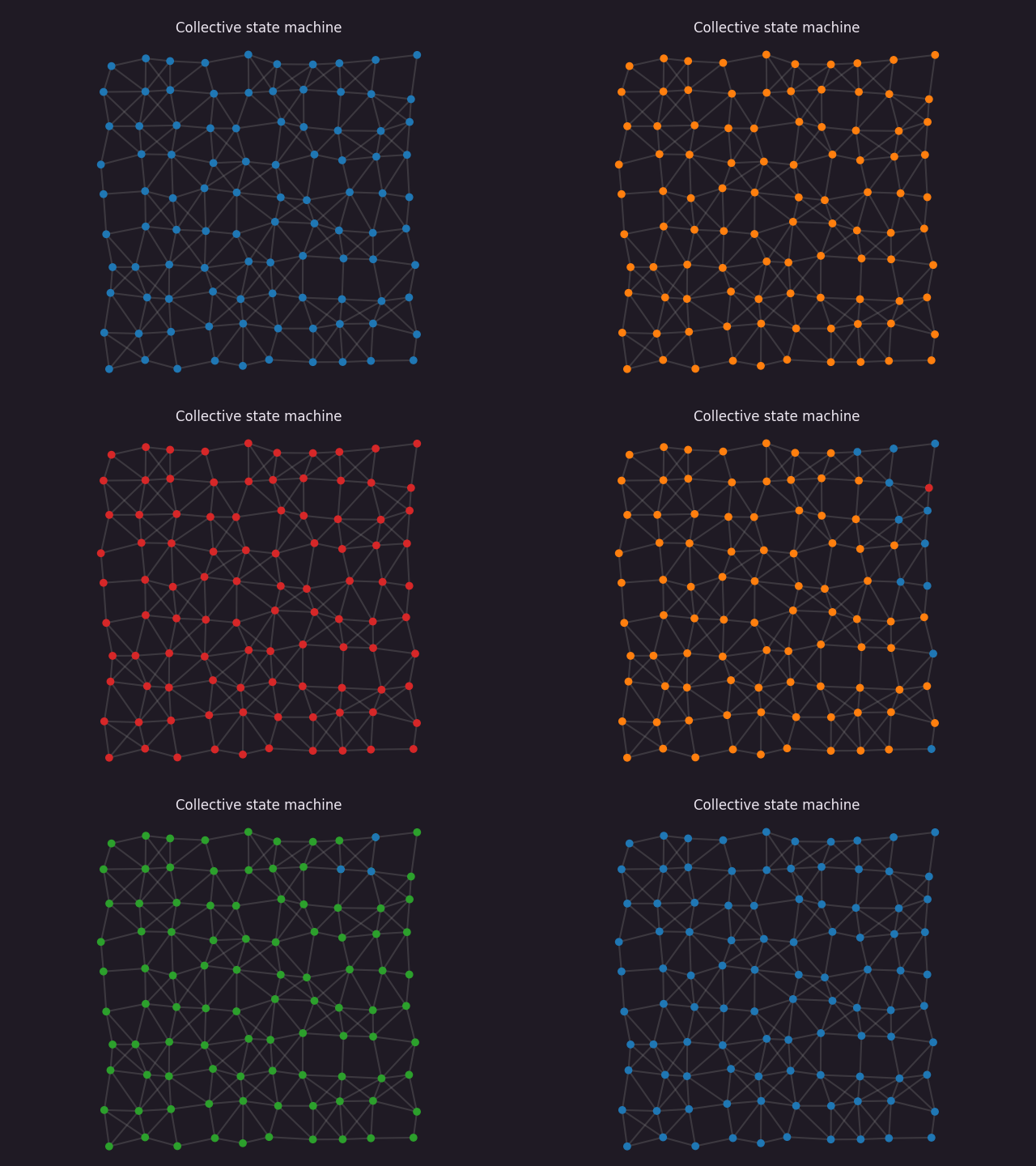
Blue is wait, orange explore, green rescue, red defend. The alarm at the base spreads explore; then the base is attacked just as the target is found, and both transitions spread from opposite corners: defend has the higher priority, and takes over the drones that had moved to rescue. Once the base is safe, the swarm waits, explores again, rescues the target, and waits.
The complete example is
docs/examples/mission.py.
A single transition function
StateMachine is built on collective_state_machine(initial, transition), which takes
the whole machine as one function: given the state, it returns the next one, as a bare
state or as Next(state, priority), and returns the state the device agreed on.
from phyelds.experimental.state_machines import Next, collective_state_machine

def step(state):
    if state == "wait" and sense("attack"):
        return Next("defend", priority=math.inf)
    return state

state = collective_state_machine("wait", step)
Its states are sent as they are, and compared with < to settle conflicts of equal
priority.
Compressed histories
A history grows with every transition, and so do the messages. With window=, each
device forgets the entries older than window time units, keeping at least two, and
counts those it forgot (Definition 7, Section 3.1):
mission = StateMachine("wait", "explore", "defend", window=60.0)
Each entry records when its state was entered, on an approximately shared clock: the
time sensor (local_time()), or the clock given to run. To take the maximum, the
histories are aligned on their forgotten entries: a history smaller than another at
their first incompatible entry is dropped, and the others are merged (Definition 8). If
the window is longer than the time a message takes to cross the network, the machine
behaves as with the whole history.