Leader election & aggregate processes
This page covers self-organizing symmetry breaking (Leader Election, the S block) and dynamic, spatially/temporally scoped computations (Aggregate Processes, @process / spawn).
Leader election: phyelds.libraries.leader_election
Leader election (S — Sparse Choice) breaks symmetry across a homogeneous network, electing a set of leaders spaced roughly area distance units apart.
| Function | Returns |
|---|---|
elect_leader(area, distances=None, *, strategy=None) |
The node ID of the leader elected for this device's region |
elect_leaders(area, distances=None, *, strategy=None) |
True on devices elected as regional leaders, False on followers |
area must be a finite positive bound: it defines the competition radius of each leader so that candidacies of disappeared leaders expire and the election remains self-stabilizing.
Election strategies
uuid_competition()(default): breaks symmetry using random UUIDs propagated over a bounded gradient.candidacy(strength=None): deterministic, priority-based bounded election (from FCPP / ACSOS 2022) with loop-free path validation. By default, lower(strength, local_id())wins; pass a customstrengthmetric (such as negative battery level) to prefer stronger candidates.
Partitioning the network into Voronoi clusters (S → G)
Pairing elect_leaders (S) with broadcast (G) partitions the entire network into self-healing Voronoi regions centered on the elected leaders:
from phyelds.calculus import aggregate
from phyelds.libraries.device import local_id
from phyelds.libraries.distances import neighbors_distances
from phyelds.libraries.leader_election import candidacy, elect_leaders
from phyelds.libraries.spreading import broadcast

@aggregate
def cluster_id(grain: float = 4.5) -> int:
    distances = neighbors_distances()
    is_leader = elect_leaders(grain, distances, strategy=candidacy())
    return broadcast(is_leader, local_id(), distances)
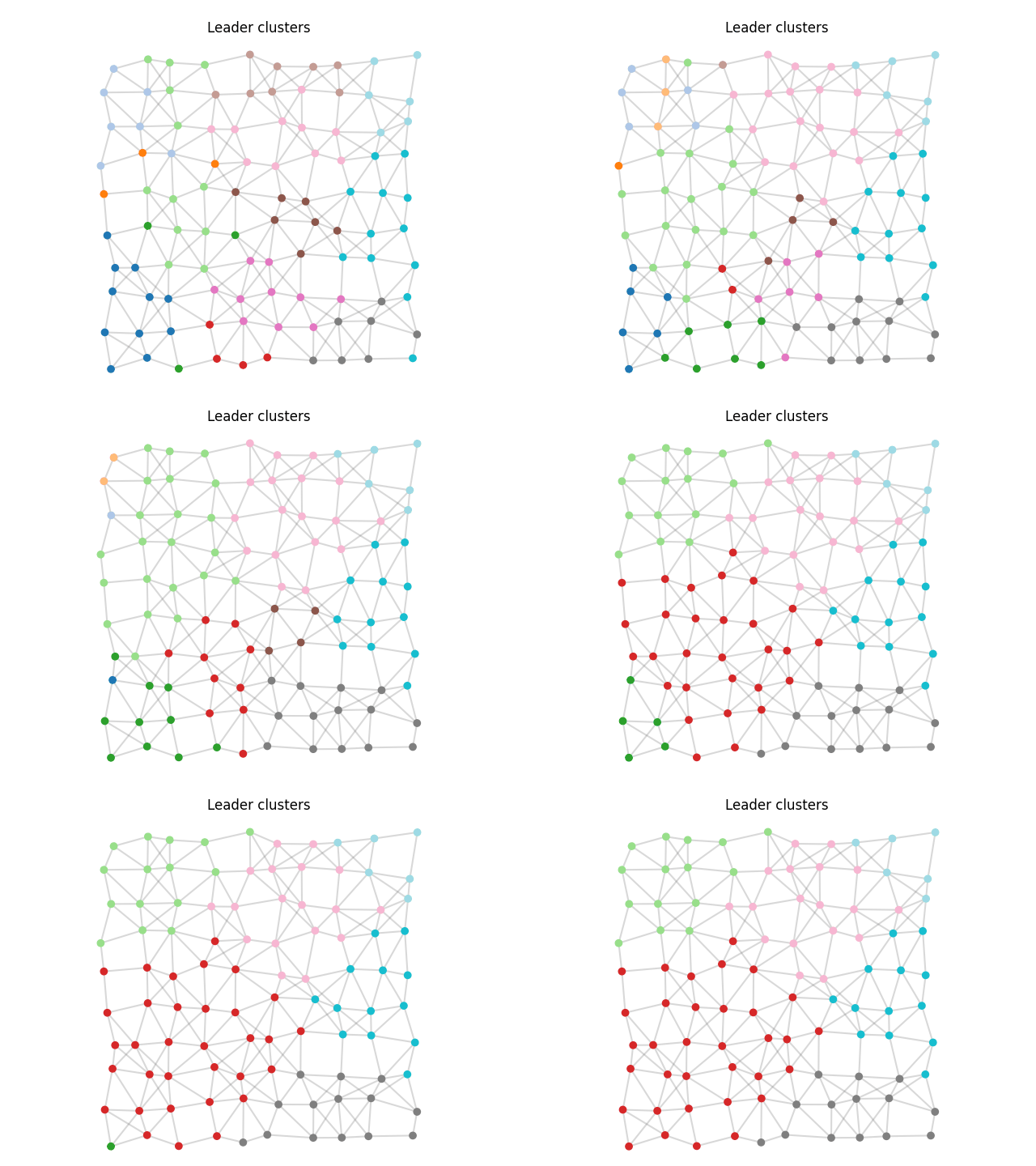
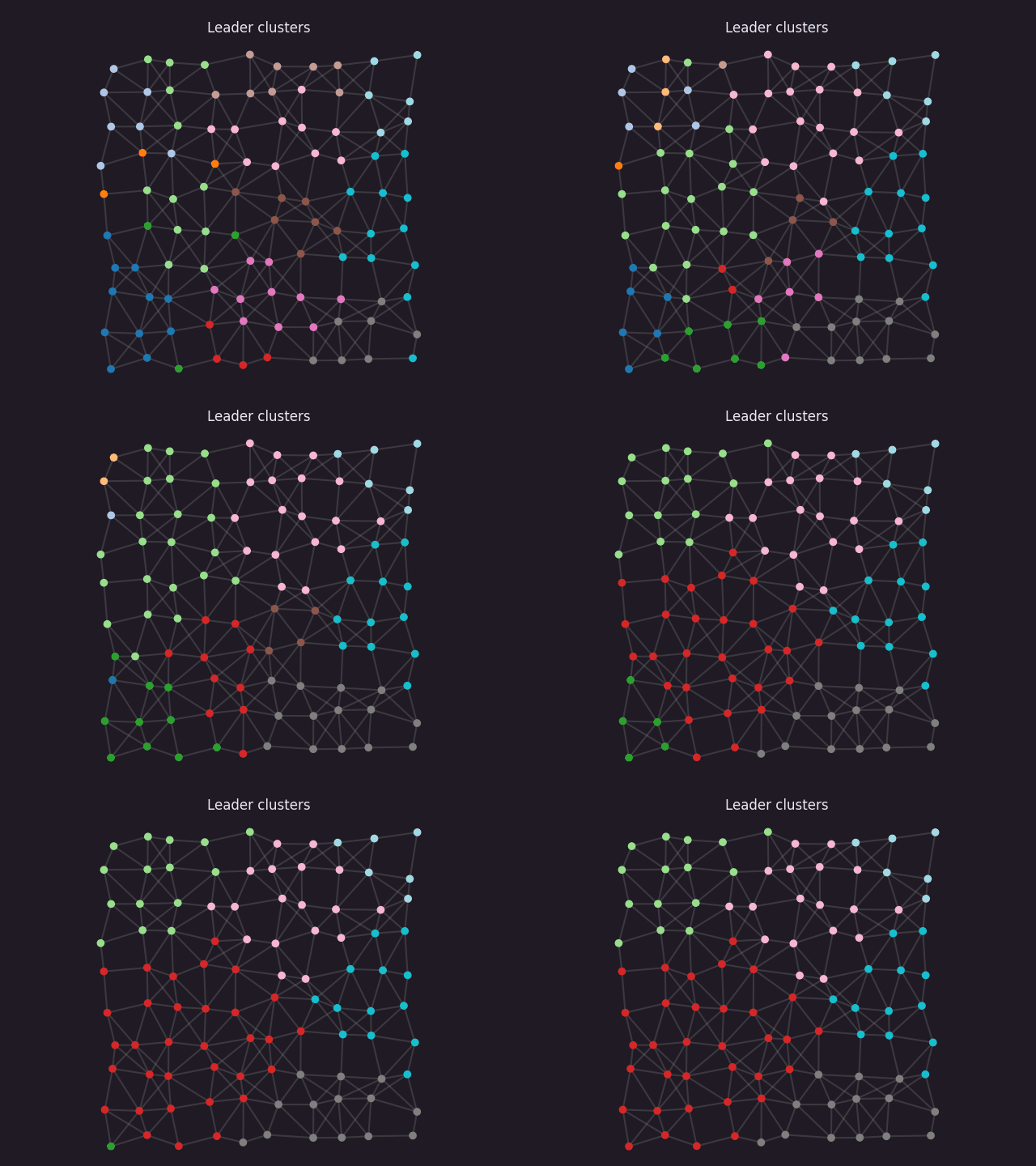
Run leader clusters in the playground
Aggregate processes: phyelds.libraries.processes
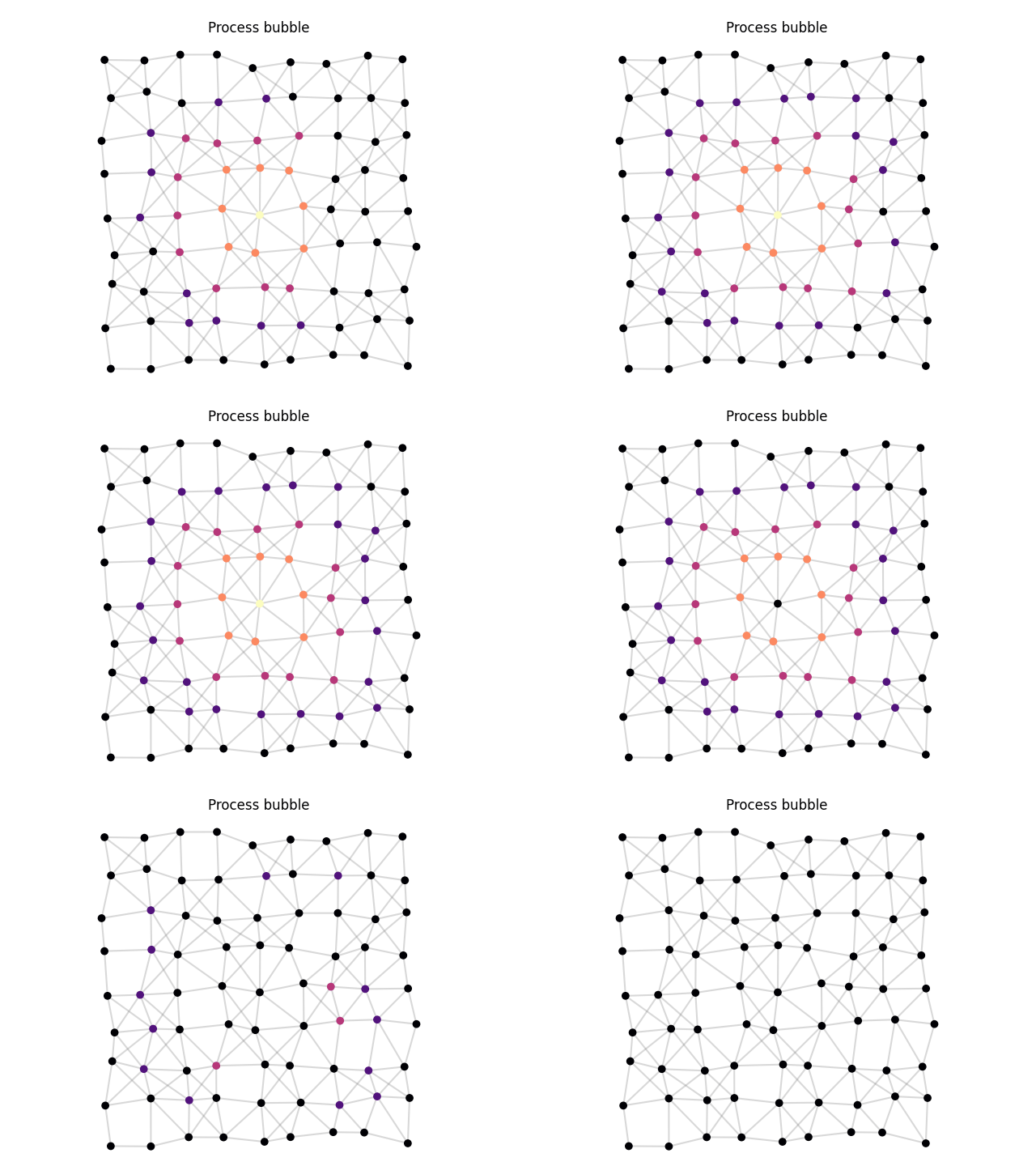
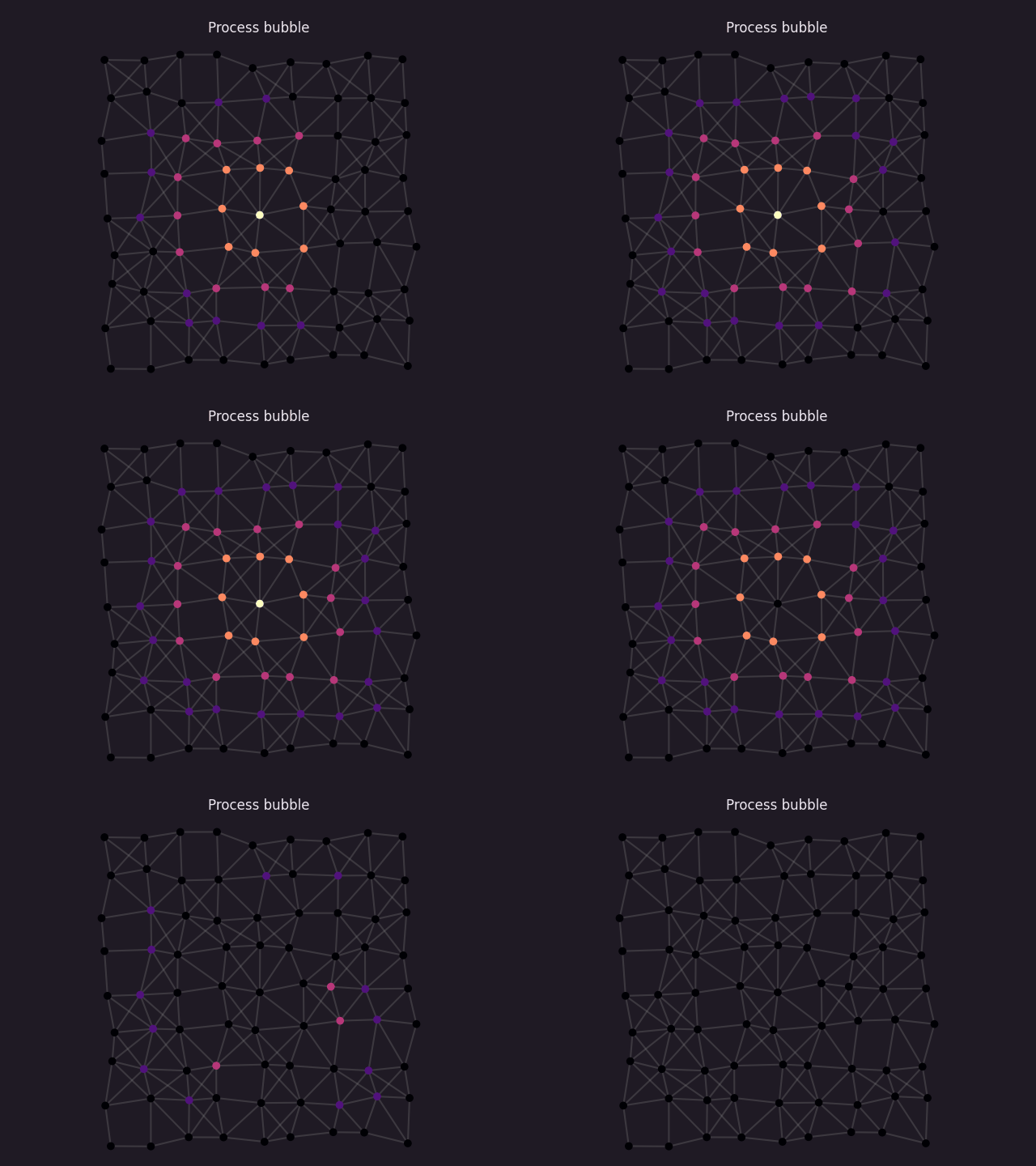
Standard @aggregate functions run a single global field across the network. Aggregate processes (inspired by ScaFi's spawn) let any device dynamically start multiple concurrent, spatially and temporally bounded field computations—called bubbles—identified by arbitrary keys (such as an event ID, a target ID, or a user request).
How a process bubble works
Decorate a function with @process and launch instances with fn.spawn(keys, *args, **kwargs) (or spawn(fn, keys, *args, **kwargs)), where keys is the set of process keys generated locally on this device in the current round.
Each active bubble instance goes through four lifecycle states on each node:
Entered when a key is in local keys or received from an active neighbor. Runs the body, relays messages, and emits its result in the returned dict.
Participates in the process and relays messages to neighbors, but hides this device's return value from the dict returned by spawn.
Immediately leaves the bubble, stops executing the remaining lines, and discards local state and outgoing messages for this key.
Broadcasts a refractory shutdown wave across the bubble so all participating nodes cleanly extinguish the process instance.
Controlling bubble scope and termination
Inside a @process function, you return normal Python values and control the bubble's spatial boundary and lifetime with guard functions or the bubble context manager:
| Construct | Meaning |
|---|---|
in_bubble(condition) / leave() |
Keeps the device inside the bubble while condition is True; when False, exits immediately (EXTERNAL), discarding state and messages |
terminate_if(condition) / terminate() |
Triggers a refractory termination wave that cleanly shuts down the entire bubble across all participating nodes (TERMINATED) |
emit_if(condition) |
When False, the device still participates as an internal relay (BUBBLE) but omits its entry from the dictionary returned by spawn |
with bubble(inside=..., terminate=..., emit=...): |
Context manager combining terminate_if, in_bubble, and emit_if |
from phyelds.calculus import aggregate
from phyelds.libraries.collect import count_nodes
from phyelds.libraries.device import local_id, sense
from phyelds.libraries.processes import in_bubble, process, terminate_if
from phyelds.libraries.spreading import broadcast, distance_to

@process
def alert_bubble(origin_id: int, max_hops: float = 3.0) -> int:
    is_origin = local_id() == origin_id
    dist = float(distance_to(is_origin))
    terminate_if(is_origin and sense("clear"))   # (1)!
    in_bubble(dist <= max_hops)                  # (2)!
    # Only devices within max_hops of origin_id execute the lines below
    return int(broadcast(is_origin, count_nodes(dist)))

@aggregate
def program() -> dict[int, int]:
    new_alerts = {local_id()} if sense("alarm") else set()
    return alert_bubble.spawn(new_alerts, max_hops=3.0)
- When the origin device senses
"clear", a termination wave shuts down the entireorigin_idbubble across the network. - Devices farther than
max_hopshops immediately leave the bubble (EXTERNAL) and do not execute or relay the process further.